
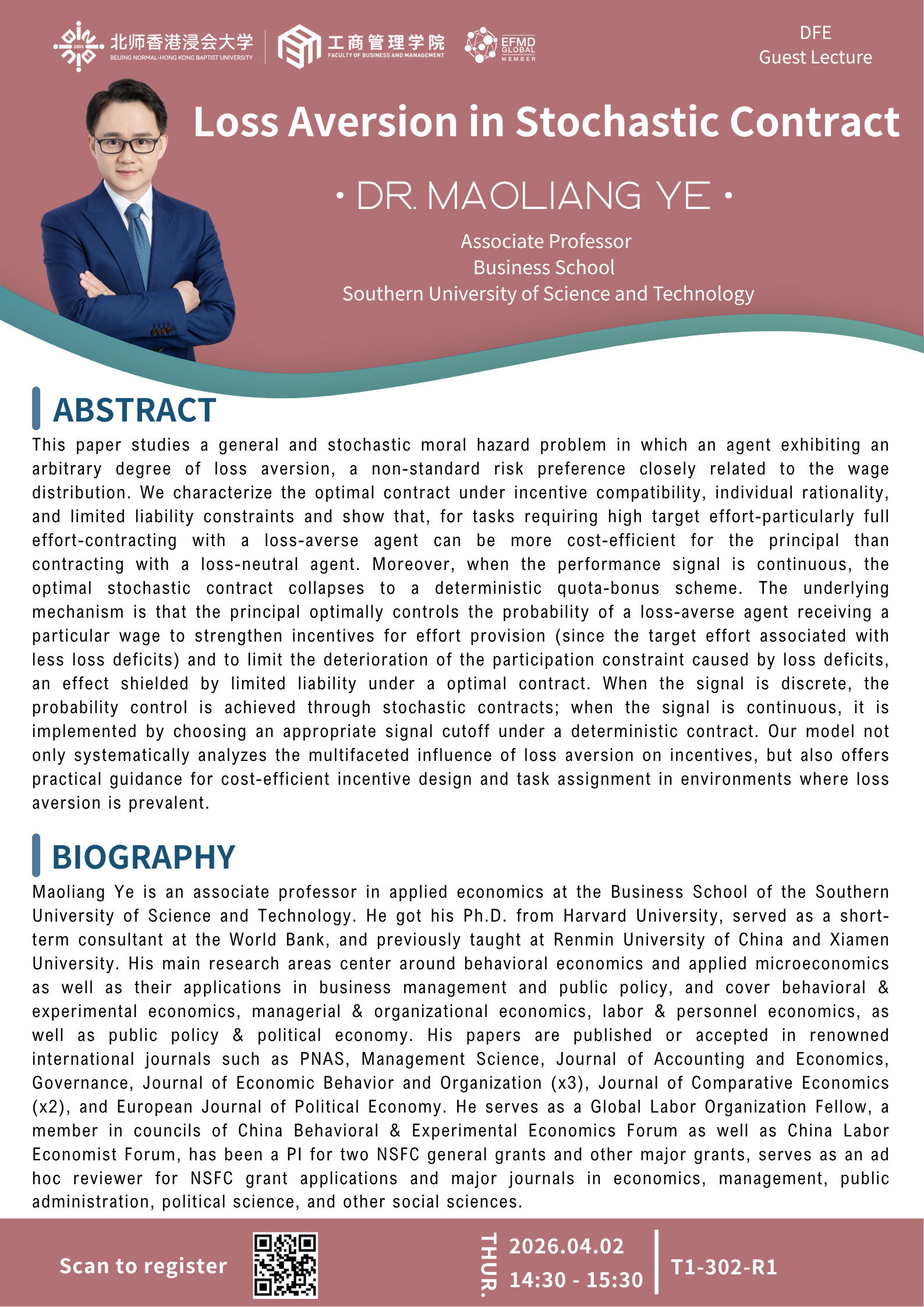
Topic: Loss Aversion in Stochastic Contract
Date: April 2, 2026 (Thursday)
Time: 14:30 - 15:30
Venue: T1-302-R1
Language: English
Abstract: This paper studies a general and stochastic moral hazard problem in which an agent exhibiting an arbitrary degree of loss aversion, a non-standard risk preference closely related to the wage distribution. We characterize the optimal contract under incentive compatibility, individual rationality, and limited liability constraints and show that, for tasks requiring high target effort-particularly full effort-contracting with a loss-averse agent can be more cost-efficient for the principal than contracting with a loss-neutral agent. Moreover, when the performance signal is continuous, the optimal stochastic contract collapses to a deterministic quota-bonus scheme. The underlying mechanism is that the principal optimally controls the probability of a loss-averse agent receiving a particular wage to strengthen incentives for effort provision (since the target effort associated with less loss deficits) and to limit the deterioration of the participation constraint caused by loss deficits, an effect shielded by limited liability under a optimal contract. When the signal is discrete, the probability control is achieved through stochastic contracts; when the signal is continuous, it is implemented by choosing an appropriate signal cutoff under a deterministic contract. Our model not only systematically analyzes the multifaceted influence of loss aversion on incentives, but also offers practical guidance for cost-efficient incentive design and task assignment in environments where loss aversion is prevalent.
Biography: Maoliang Ye is an associate professor in applied economics at the Business School of the Southern University of Science and Technology. He got his Ph.D. from Harvard University, served as a short-term consultant at the World Bank, and previously taught at Renmin University of China and Xiamen University. His main research areas center around behavioral economics and applied microeconomics as well as their applications in business management and public policy, and cover behavioral & experimental economics, managerial & organizational economics, labor & personnel economics, as well as public policy & political economy. His papers are published or accepted in renowned international journals such as PNAS, Management Science, Journal of Accounting and Economics, Governance, Journal of Economic Behavior and Organization (x3), Journal of Comparative Economics (x2), and European Journal of Political Economy. He serves as a Global Labor Organization Fellow, a member in councils of China Behavioral & Experimental Economics Forum as well as China Labor Economist Forum, has been a PI for two NSFC general grants and other major grants, serves as an ad hoc reviewer for NSFC grant applications and major journals in economics, management, public administration, political science, and other social sciences.


Channels

©2024-2025 Beijing Normal-Hong Kong Baptist University(BNBU). All Rights Reserved.粤ICP备07509519号粤公网安备44049102496044.