"Energy Darwinism: From Big Bang to Intelligence" & "Intelligence, Situation Awareness, and Context Sensitive Choice: From Brain Plasticity to Consciousness to Incentive", Prof. CHEW Soo Hong, National University of Singapore
Speaker:
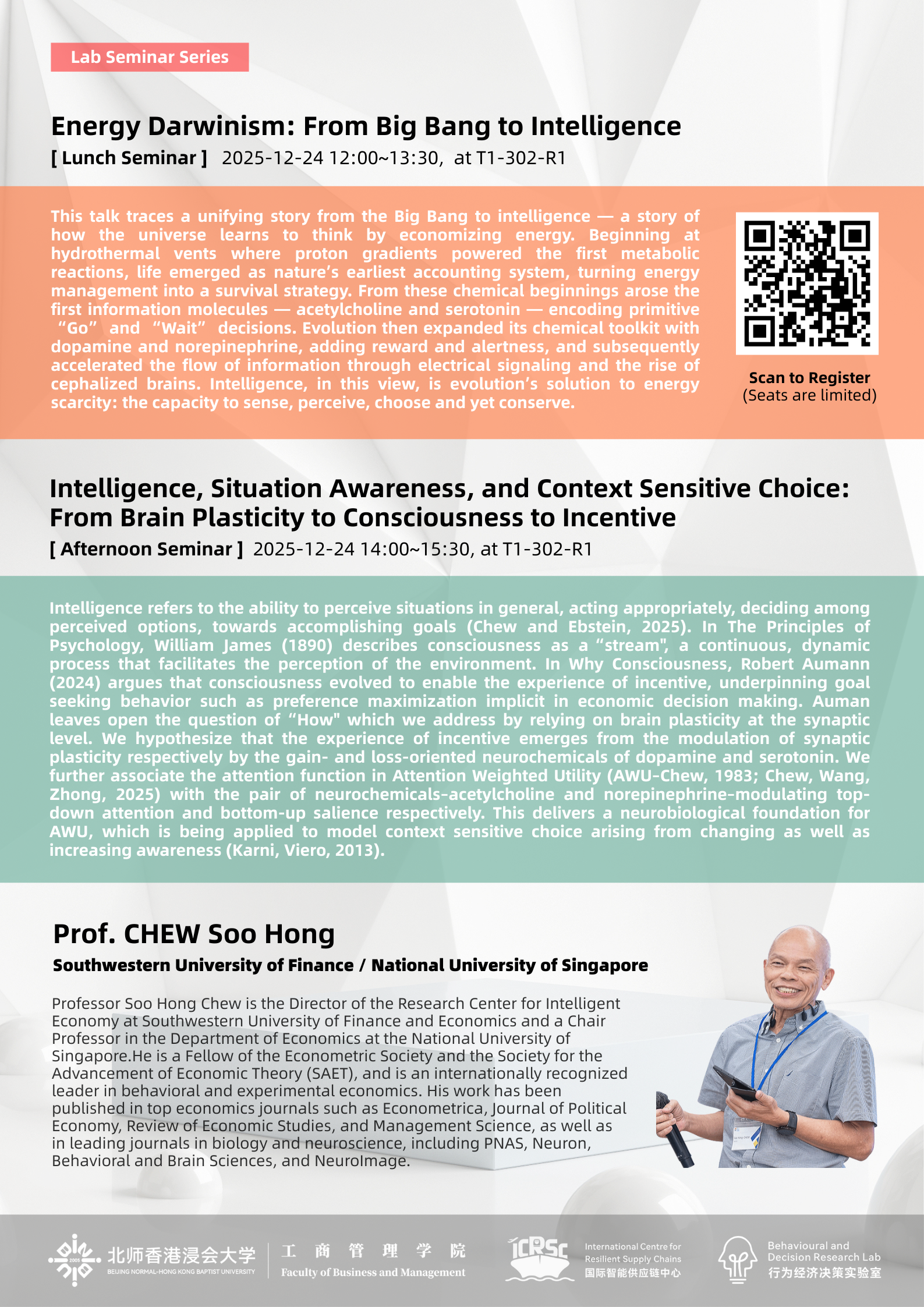
Prof. CHEW Soo Hong is the Director of the Research Center for Intelligent Economy at Southwestern University of Finance and Economics and a Chair Professor in the Department of Economics at the National University of Singapore. He is a Fellow of the Econometric Society and the Society for the Advancement of Economic Theory (SAET), and is an internationally recognized leader in behavioral and experimental economics. His work has been published in top economics journals such as Econometrica, Journal of Political Economy, Review of Economic Studies, and Management Science, as well as in leading journals in biology and neuroscience, including PNAS, Neuron, Behavioral and Brain Sciences, and NeuroImage.
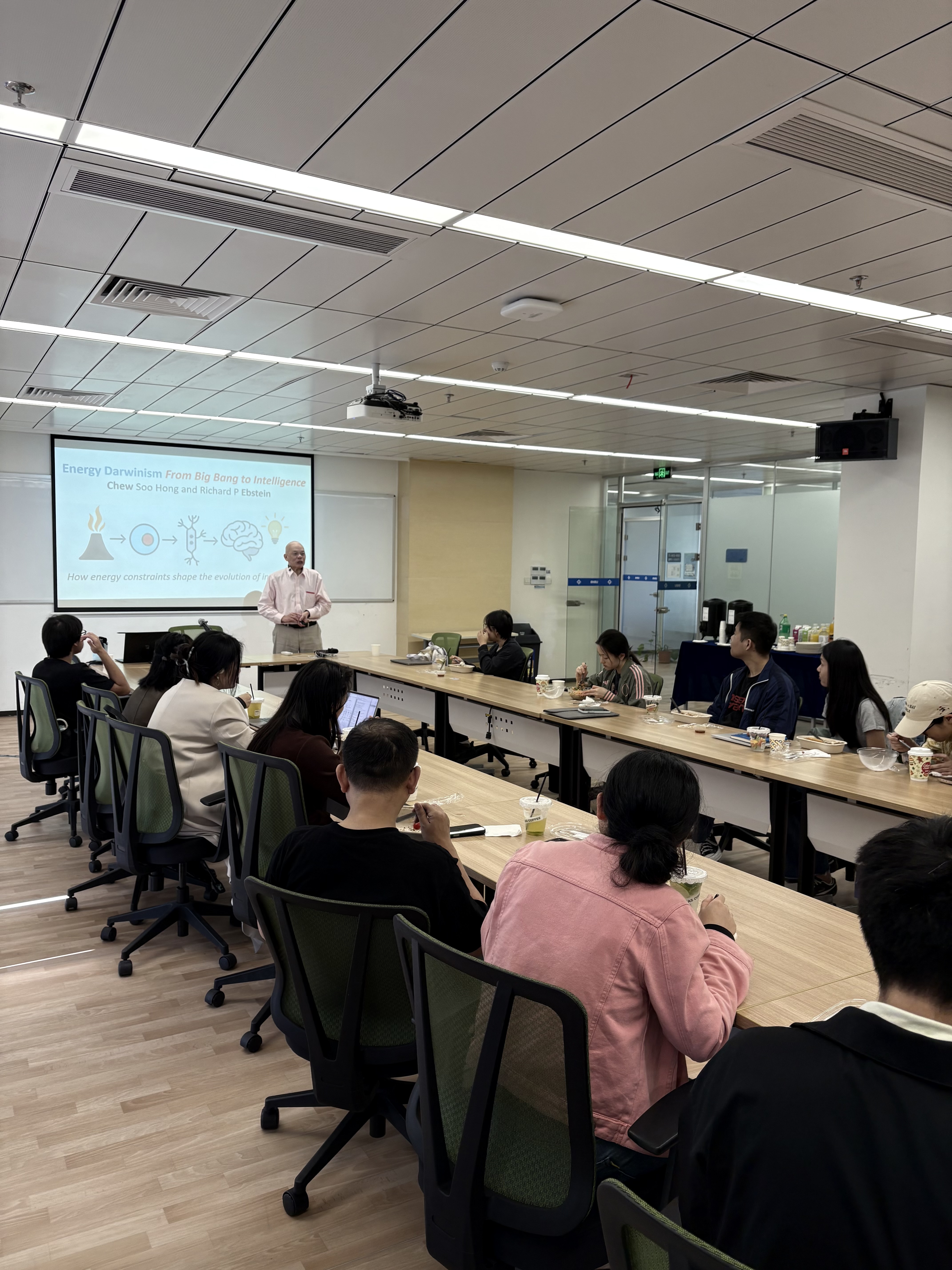
Lunch Seminar:
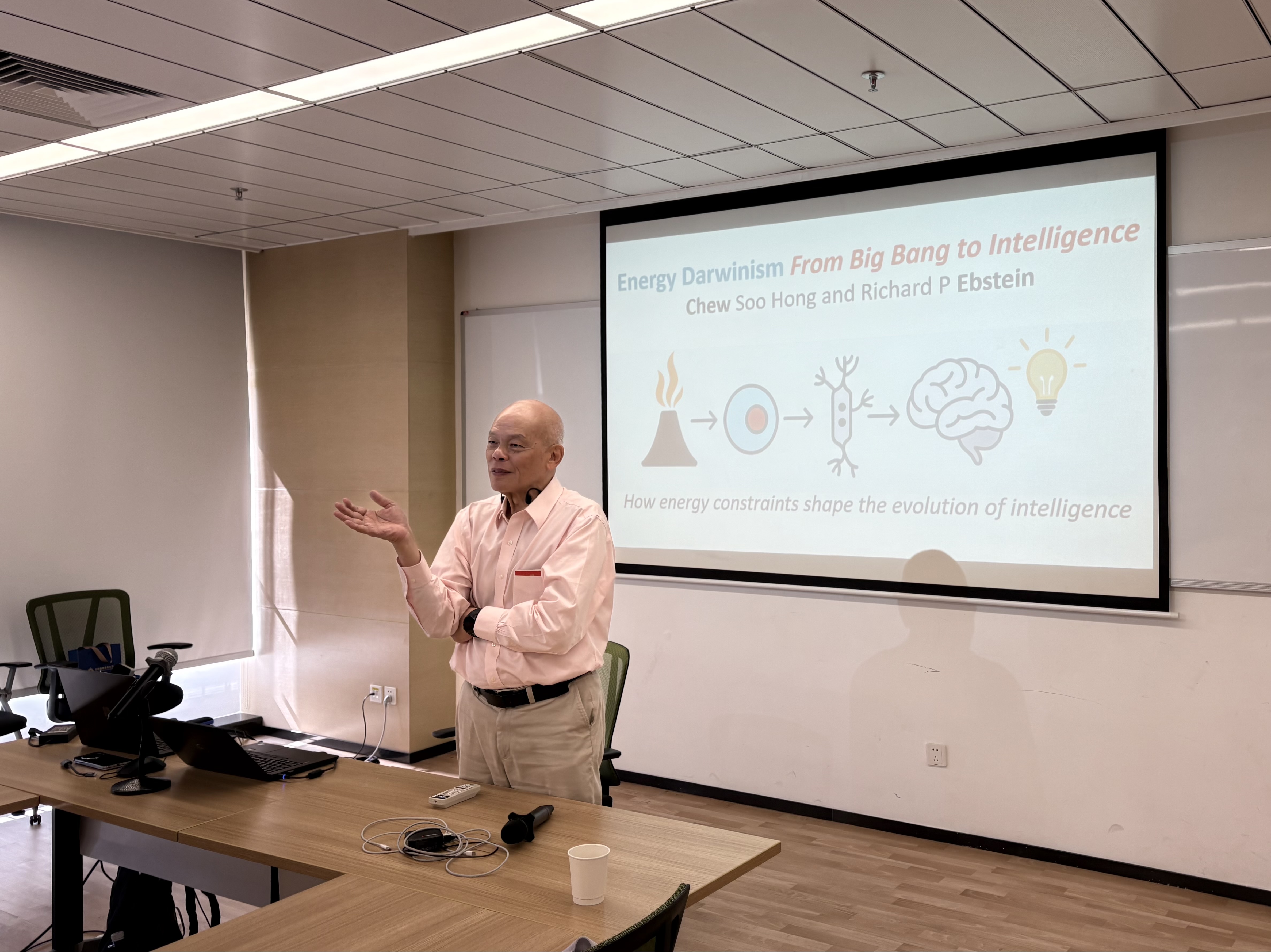
Title:Energy Darwinism: From Big Bang to Intelligence
Date:2025-12-24 (Wednesday)
Time: 12:00–13:30
Venue:T1-302-R1
Abstract:
This talk traces a unifying story from the Big Bang to intelligence — a story of how the universe learns to think by economizing energy. Beginning at hydrothermal vents where proton gradients powered the first metabolic reactions, life emerged as nature’s earliest accounting system, turning energy management into a survival strategy. From these chemical beginnings arose the first information molecules — acetylcholine and serotonin — encoding primitive “Go” and “Wait” decisions. Evolution then expanded its chemical toolkit with dopamine and norepinephrine, adding reward and alertness, and subsequently accelerated the flow of information through electrical signaling and the rise of cephalized brains. Intelligence, in this view, is evolution’s solution to energy scarcity: the capacity to sense, perceive, choose and yet conserve.
Afternoon Seminar:
Title:Intelligence, Situation Awareness, and Context Sensitive Choice: From Brain Plasticity to Consciousness to Incentive
Date:2025-12-24 (Wednesday)
Time: 14:00–15:30
Venue:T1-302-R1
Abstract:
Intelligence refers to the ability to perceive situations in general, acting appropriately and choosing among perceived options, towards accomplishing goals (Chew and Ebstein, 2025). In The Principles of Psychology, William James (1890) describes consciousness as a “stream", a continuous, dynamic process that facilitates the perception of the environment. In Why Consciousness, Robert Aumann (2024) argues that consciousness evolved to enable the experience of incentive, underpinning goal seeking behavior such as preference maximization implicit in economic decision making. Auman leaves open the question of “How” which we address by relying on brain plasticity at the synaptic level. We hypothesize that the experience of incentive emerges from the modulation of synaptic plasticity respectively by the gain- and loss-oriented neurochemicals of dopamine and serotonin. We further associate the attention function in Attention Weighted Utility (AWU – Chew, 1983; Chew, Wang, Zhong, 2025) with the pair of neurochemicals – acetylcholine and norepinephrine – modulating top-down attention and bottom-up salience respectively. This delivers a neurobiological foundation for AWU, which is being applied to model context sensitive choice situation arising from changing as well as increasing awareness (Karni, Viero, 2013).
References:
- Aumann R (2024) “Why consciousness?” Neuropsychologia:196:108803
- Williams J (1890) The Principles of Psychology, New York : Holt
- Chew SH (1983) “A Generalization of the Quasilinear Mean with Applications to the Measurement of Income Inequality and Decision Theory Resolving the Allais Paradox”, Econometrica 51, 1065–1092
- Chew SH and Ebstein RP (2025), Energy Darwinism: From Big Bang to Intelligence. Work-in-progress
- Chew SH, Wang WQ, Zhong SF (2025), “A Theory of Attention Weighted Utility”, Working Paper
- Karni E, Viero M-L (2013), “Reverse Bayesianism: A Choice-Based Theory of Growing Awareness”, American Economic Review 103, 2790–2810