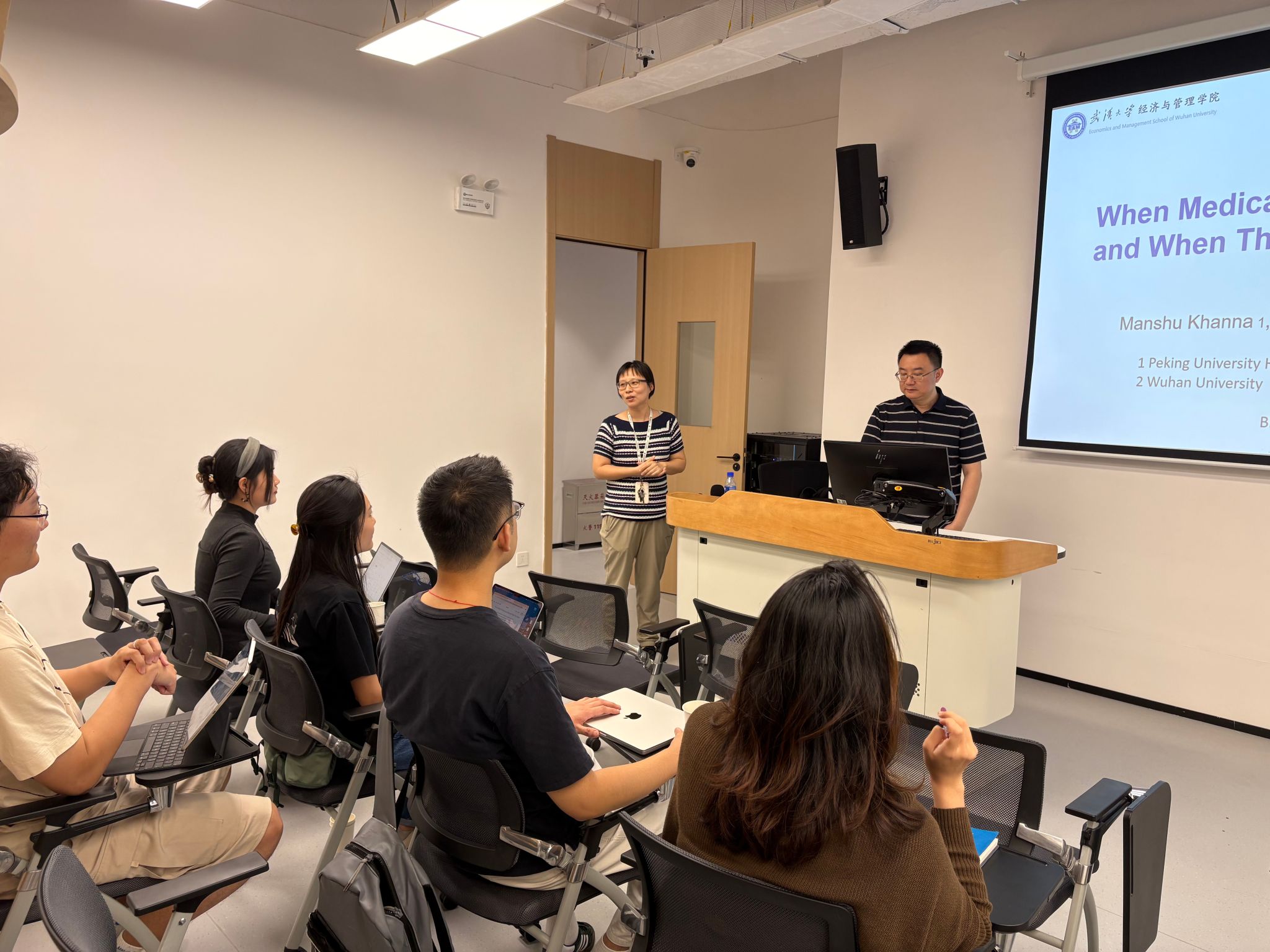
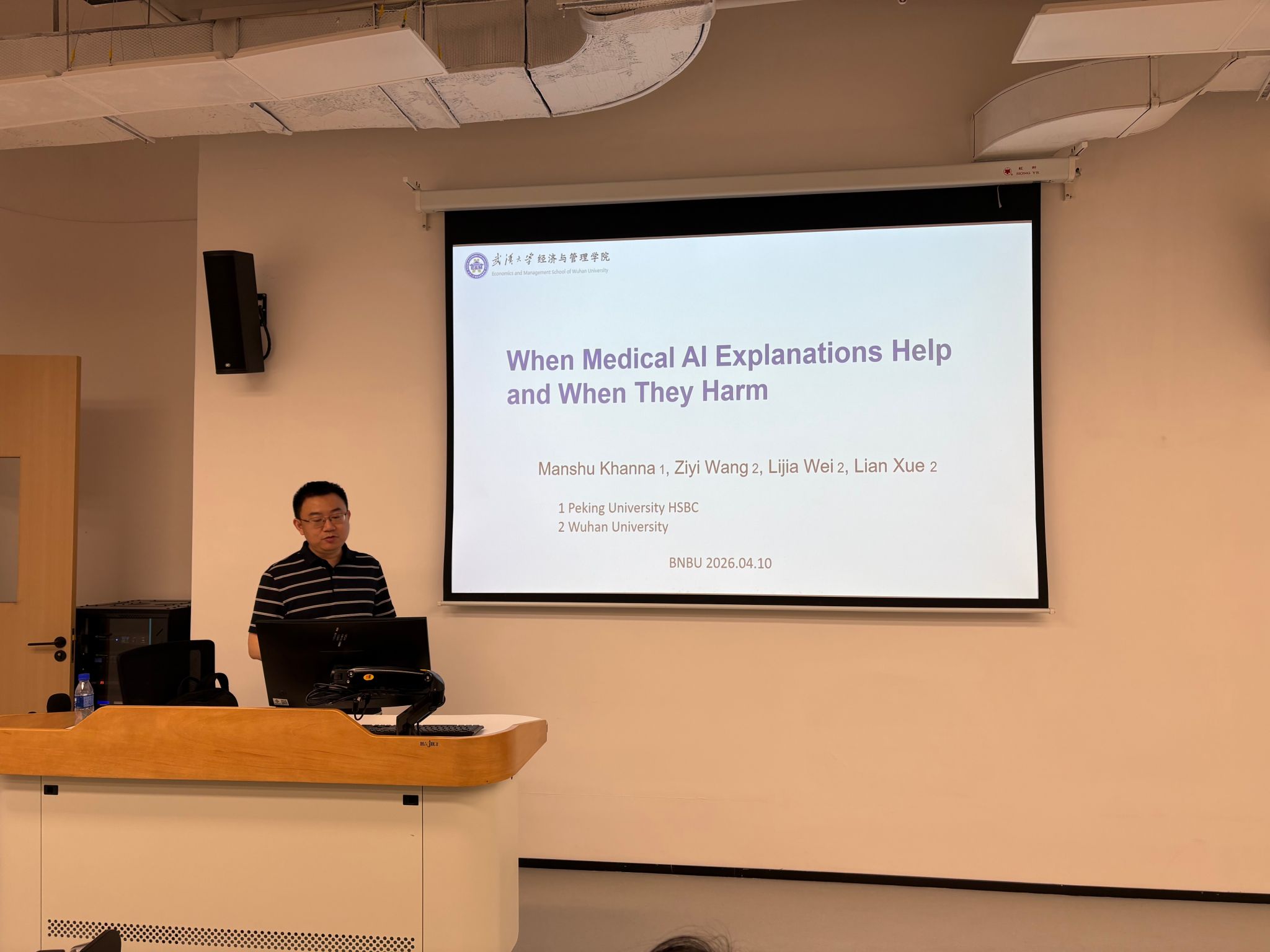
"When Medical AI Explanations Help and When They Harm", Prof. Lijia WEI, School of Economics and Management, Wuhan University
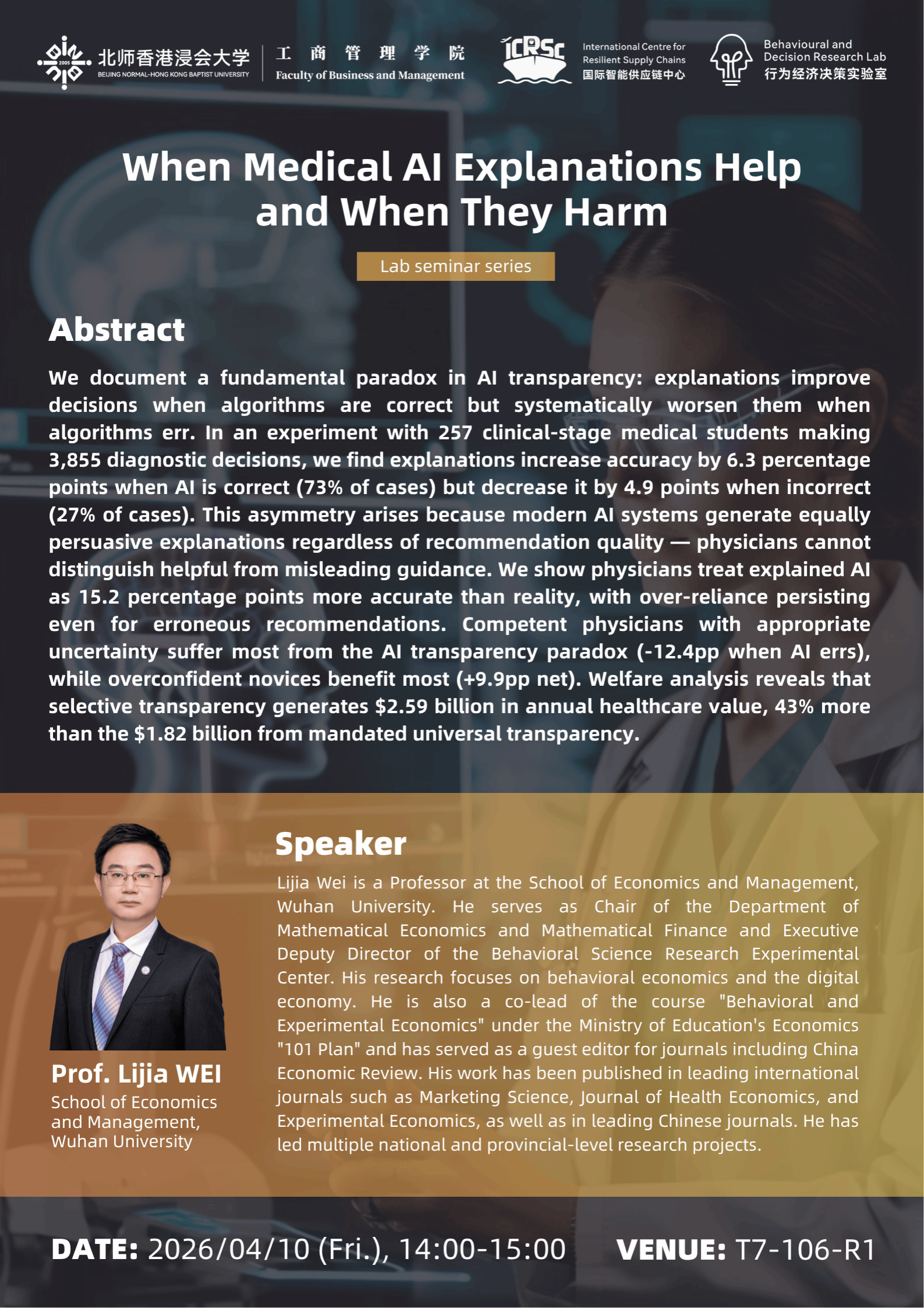
Title: When Medical AI Explanations Help and When They Harm
Speaker: Prof. Lijia WEI, School of Economics and Management, Wuhan University
Date: April 10, 2026 (Friday)
Time: 14:00–15:00
Location: T7-106-R1
Abstract:
We document a fundamental paradox in AI transparency: explanations improve decisions when algorithms are correct but systematically worsen them when algorithms err. In an experiment with 257 clinical-stage medical students making 3,855 diagnostic decisions, we find explanations increase accuracy by 6.3 percentage points when AI is correct (73% of cases) but decrease it by 4.9 points when incorrect (27% of cases). This asymmetry arises because modern AI systems generate equally persuasive explanations regardless of recommendation quality — physicians cannot distinguish helpful from misleading guidance. We show physicians treat explained AI as 15.2 percentage points more accurate than reality, with over-reliance persisting even for erroneous recommendations. Competent physicians with appropriate uncertainty suffer most from the AI transparency paradox (-12.4pp when AI errs), while overconfident novices benefit most (+9.9pp net). Welfare analysis reveals that selective transparency generates $2.59 billion in annual healthcare value, 43% more than the $1.82 billion from mandated universal transparency.
Speaker Bio:
Lijia Wei is a Professor at the School of Economics and Management, Wuhan University. He serves as Chair of the Department of Mathematical Economics and Mathematical Finance and Executive Deputy Director of the Behavioral Science Research Experimental Center. His research focuses on behavioral economics and the digital economy. Professor Wei is a co-lead of the course "Behavioral and Experimental Economics" under the Ministry of Education's Economics "101 Plan" and has served as a guest editor for international journals including China Economic Review. His research has been published in leading international journals such as Marketing Science, Econometric Theory, Journal of Health Economics, Experimental Economics, European Economic Review, and AEA: Papers and Proceedings, as well as leading Chinese journals. He has led multiple national research projects, including Key, General, and Young Scholar grants from the National Natural Science Foundation of China, the Humanities and Social Sciences Fund of the Ministry of Education, and a High-Level International Talent Introduction Program of the Ministry of Science and Technology.