You are cordially invited to DM Seminar jointly organized by the Department of Management (DM), Faculty of Business and Management (FBM), and School of AI and Liberal Arts (SAI). Details of the seminar are as follows:
Topic:
Two Empirical Studies on Virtual Humans & Artificial Intelligence
Speaker:
Professor Kyung Young Lee, Faculty of Management, Dalhousie University.
Time: 4:10-5:00pm, 11 Nov 2026
Venue: T2-306
Language: English
Speaker:
Professor Kyung Young Lee is a Professor of Management Information Systems in the Faculty of Management at Dalhousie University and a researcher in the field of artificial intelligence and digital technologies. His research focuses on human–AI interaction, chatbot services, AI-driven voice assistants, smart devices, and emerging “human-less” technologies that are reshaping business and consumer experiences. With academic training in telecom engineering, statistics, management, and information systems, Professor Lee combines technical expertise with a deep understanding of organizational and consumer behavior. He has published over 50 peer-reviewed journal articles and conference proceedings examining how people interact with IT and AI-powered technologies and how these systems affect end-users and organizations.
Abstract:
In this seminar, Professor Lee will briefly introduce his recently published and ongoing research projects, followed by presentations on two studies examining virtual entertainers and GAI-generated reviews with human-mimicking errors.
Project 1: Grounded in persuasion theory, this study investigates whether Virtual Entertainers (VEs) drive consumer purchase intentions as effectively as Human Entertainers (HEs). Using text mining and an experimental survey, we examine physical attractiveness, social attractiveness, attitude homophily, and trustworthiness. Results show that physical and social attractiveness significantly drive trustworthiness for both VEs and HEs, whereas attitude homophily enhances trustworthiness only for HEs. Trustworthiness strongly correlates with music purchase intentions in both groups, moderated by emotional arousal. A multi-group analysis revealed minimal differences overall between VEs and HEs.
Project 2: As generative AI (GAI) transforms digital content creation, this study evaluates whether GAI-generated reviews elicit consumer responses comparable to human-written reviews. Guided by signaling theory, accessibility–diagnosticity, and negativity bias, three pre–post experiments compare human reviews, standard GAI reviews, and GAI reviews with human-mimicking errors across positive, negative, and mixed contexts. Results indicate consumers cannot reliably identify review authorship and show statistically similar behavioral intentions across conditions. Negativity bias remains dominant regardless of source. Ultimately, diagnostic content—rather than perceived authorship—drives consumer judgment, underscoring urgent risks of AI-driven manipulation and implications for platform governance.
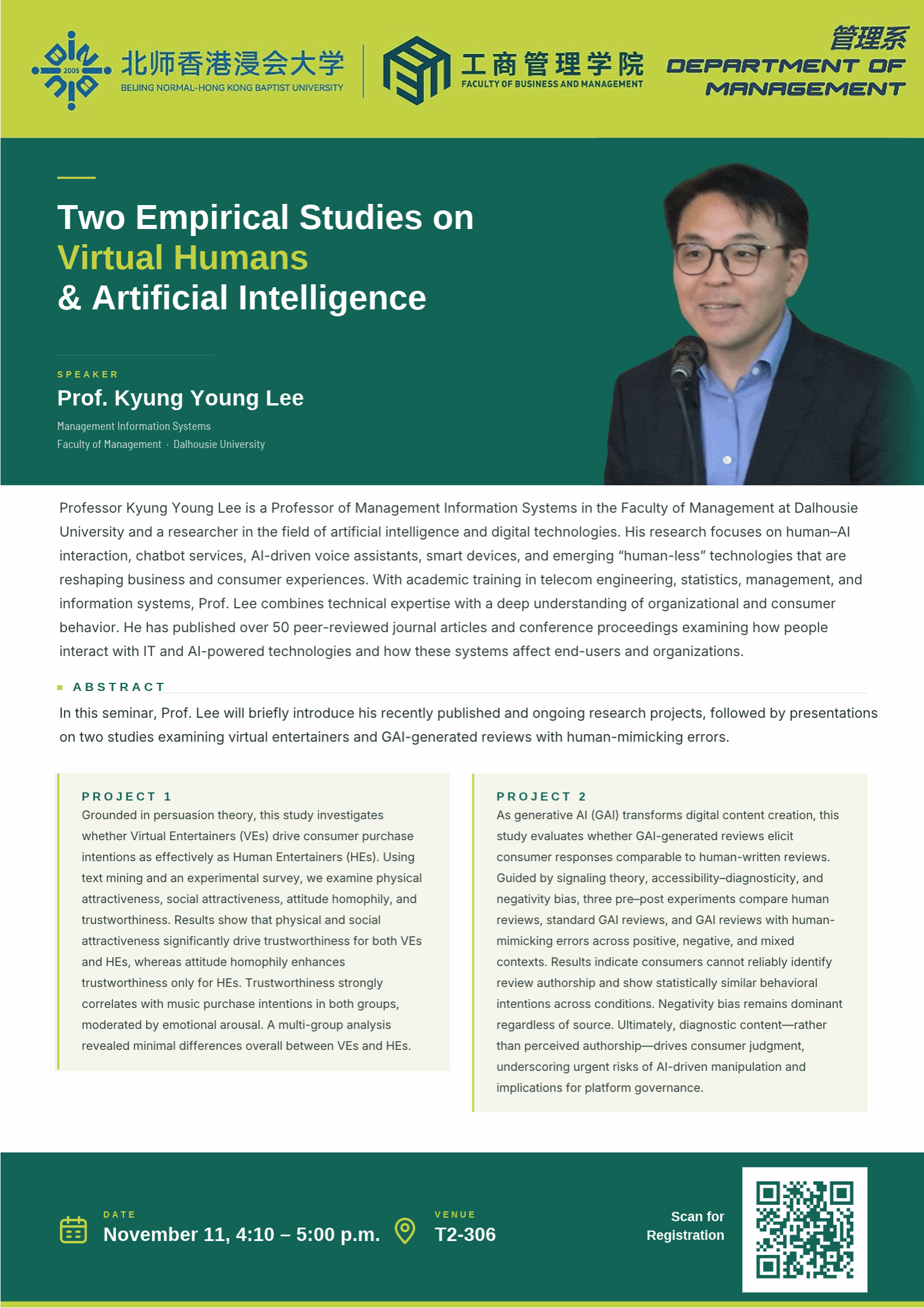
Please scan the QR code in the poster for registration.


