Who Benefits Most from Family-Supportive Supervisors? Unpacking Their Effects on Work-to-Family Conflict, Job Burnout, and Turnover Intention across Job Levels and Gender
You are cordially invited to the seminar organized by Department of Management (DM), Faculty of Business and Management (FBM). Details of the lecture are as follows:
Topic: Who Benefits Most from Family-Supportive Supervisors? Unpacking Their Effects on Work-to-Family Conflict, Job Burnout, and Turnover Intention across Job Levels and Gender
Time: 2:00-3:30pm, 23 Sep 2026
Venue: T1-108
Language: English
Speaker:
Genping Ye is a PhD candidate in Human Resource Management and Organisational Behaviour at Southampton Business School, University of Southampton, UK. Her research focuses on work-family interactions, employee well-being, occupational health, and turnover intention. Her work examines how workplace experiences and support shape employees’ ability to manage work and family demands, as well as their subsequent well-being and work-related outcomes. Her research has been published in the Journal of Vocational Behavior (ABS 4).
Abstract:
Formal family-supportive policies do not necessarily guarantee that employees can or will make use of them, making supervisors critical in shaping employees’ access to work-family support. Family-supportive supervisor behavior (FSSB) therefore represents an important source of support in helping employees manage work and family demands. This study examines how FSSB reduces turnover intention through work-to-family conflict and job burnout and, importantly, who benefits most from such support.
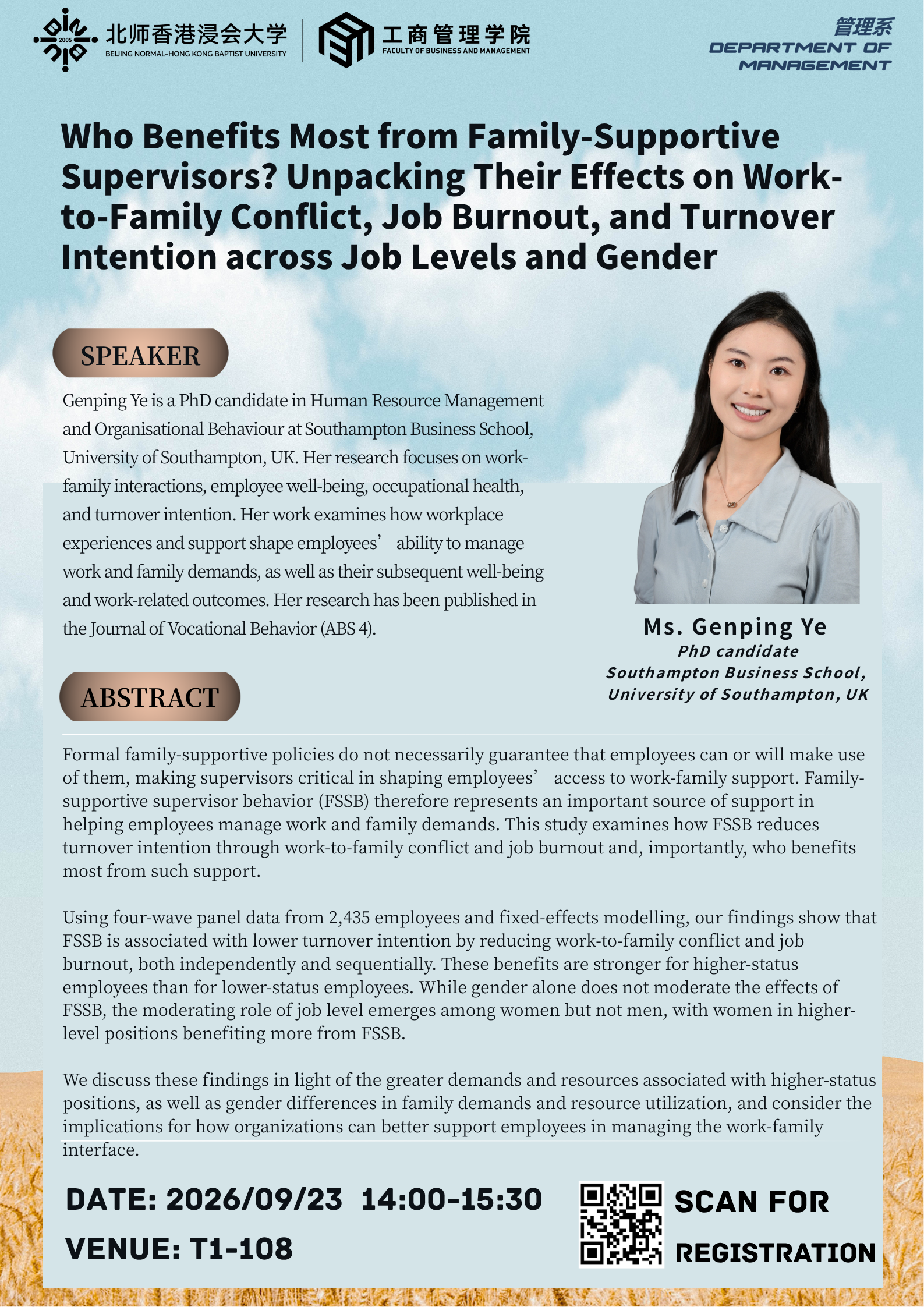
Please scan the QR code in the poster for registration.


