DM Seminar | Move Together or Move Alone? Leader-subordinate Co-mobility, Performance, and Learning in Lateral Transfers
Dear all,
You are cordially invited to the seminar organized by Department of Management (DM), Faculty of Business and Management (FBM). Details of the seminar are as follows:
Topic:
Move Together or Move Alone? Leader-subordinate Co-mobility, Performance, and Learning in Lateral Transfers
Speaker:
Time: 3:15-4:30P.M., 2 Dec. 2026
Venue: T1-108
Language: English
Speaker:
Shuning Liu is a Postdoctoral Fellow at The Hong Kong Polytechnic University. She received her Ph.D. in Management and Strategy from The University of Hong Kong in 2025. Her research examines how organizations create value from talent, focusing on how internal mobility shapes talent allocation and development, and how compensation systems motivate and reward employee contributions. Combining people analytics, field surveys, and field experiments, her work seeks to generate theoretical insights and practical solutions to talent management challenges. She has published three articles in the Journal of Vocational Behavior.
When organizations transfer leaders laterally, they decide not only where to move them but whether to move them alone or with former subordinates, which we term leader-subordinate co-mobility. Lateral transfers serve to deploy leaders’ existing capabilities and develop new ones, yet how leader-subordinate co-mobility affects either purpose is unclear: lateral mobility research assumes leaders move alone, and co-mobility research focuses on immediate performance. Drawing on human capital theory and research on employee and employer learning through lateral transfers, we argue that co-mobility shifts transfers toward productivity and away from learning. Leader-subordinate co-mobility preserves the human capital leaders have built with former subordinates, aiding deployment, but limits what leaders learn from leading unfamiliar subordinates and what organizations learn about leaders’ capability from observing them do so. Using five years of personnel data on lateral leader transfers at a leading technology company, we find that co-moving leaders outperform solo-moving leaders in the new role. Yet in their next transfer, previously co-moving leaders underperform previously solo-moving leaders, especially when that next transfer is solo. Moreover, co-moving leaders’ performance ratings are less strongly associated with subsequent promotion than those of solo-moving leaders, suggesting that co-mobility weakens performance as a signal of leaders’ own capability. Our study informs research on internal mobility and leader development.
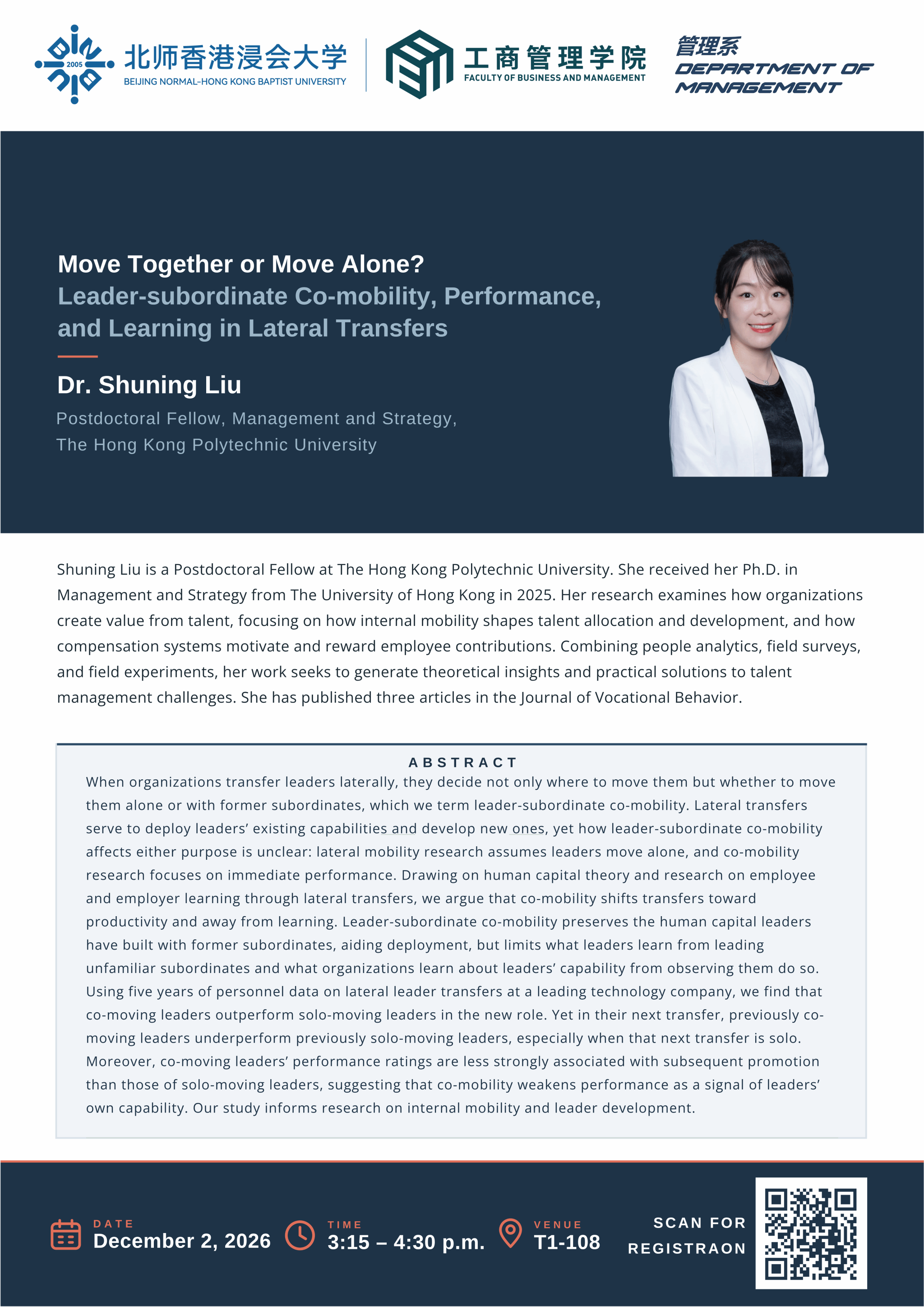
Please scan the QR code in the poster for registration.


