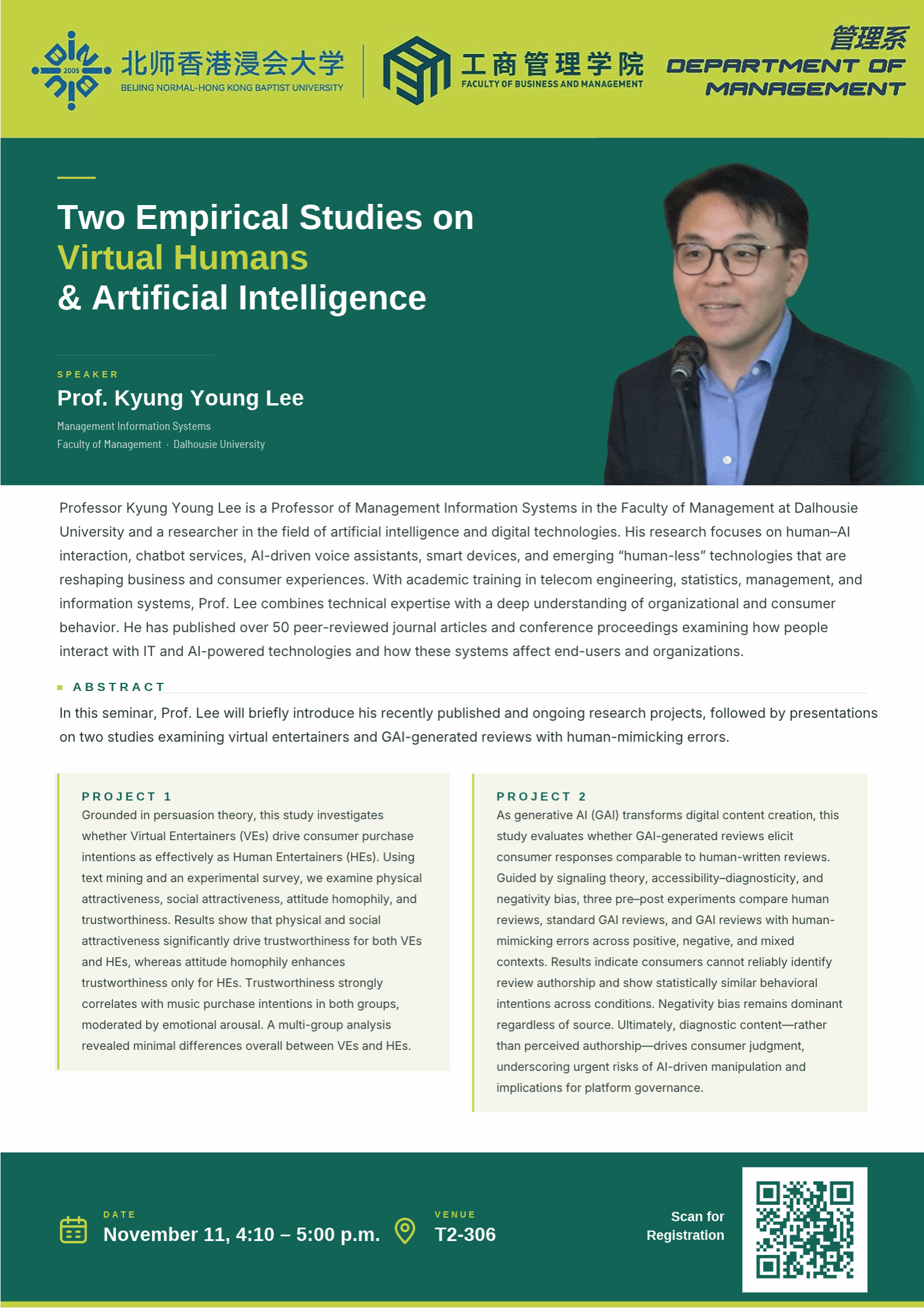
FBM(DM)-SAI联合科研讲座 |Two Empirical Studies on Virtual Humans & Artificial Intelligence
诚挚邀请您参加由管理系(DM)、工商管理学院(FBM)与博雅智能学院(SAI)联合举办的 DM 学术研讨会。具体信息如下:
讲座题目:
地点:T2-306
语言:英语
Professor Kyung Young Lee 是戴尔豪斯大学管理学院信息系统管理的教授,也是人工智能与数字技术领域的研究者。他的研究聚焦于人机交互、聊天机器人服务、AI 语音助手、智能设备,以及正在重塑商业与消费者体验的新兴“无人化”技术。Prof. Lee 先后接受过电信工程、统计学、管理学与信息系统方面的学术训练,兼具技术专长与对组织行为及消费者行为的深刻理解。他已发表 50 余篇同行评审期刊论文与会议论文,探讨人们如何与信息技术及 AI 驱动的技术互动,以及这些系统如何影响终端用户与组织。
In this seminar, Professor Lee will briefly introduce his recently published and ongoing research projects, followed by presentations on two studies examining virtual entertainers and GAI-generated reviews with human-mimicking errors.
Project 1: Grounded in persuasion theory, this study investigates whether Virtual Entertainers (VEs) drive consumer purchase intentions as effectively as Human Entertainers (HEs). Using text mining and an experimental survey, we examine physical attractiveness, social attractiveness, attitude homophily, and trustworthiness. Results show that physical and social attractiveness significantly drive trustworthiness for both VEs and HEs, whereas attitude homophily enhances trustworthiness only for HEs. Trustworthiness strongly correlates with music purchase intentions in both groups, moderated by emotional arousal. A multi-group analysis revealed minimal differences overall between VEs and HEs.
Project 2: As generative AI (GAI) transforms digital content creation, this study evaluates whether GAI-generated reviews elicit consumer responses comparable to human-written reviews. Guided by signaling theory, accessibility–diagnosticity, and negativity bias, three pre–post experiments compare human reviews, standard GAI reviews, and GAI reviews with human-mimicking errors across positive, negative, and mixed contexts. Results indicate consumers cannot reliably identify review authorship and show statistically similar behavioral intentions across conditions. Negativity bias remains dominant regardless of source. Ultimately, diagnostic content—rather than perceived authorship—drives consumer judgment, underscoring urgent risks of AI-driven manipulation and implications for platform governance.